
Kruger National Park - a Must-Visit for Worldschooling Families
Updated: Feb 17
Growing up in Mozambique, some of my most vivid childhood memories are of family trips across the border into South Africa's Kruger National Park. The anticipation of those long drives, the sudden glimpse of an elephant emerging from the bush, and the thrill of spotting a pride of lions at dusk—these moments shaped my early sense of wonder about the natural world. Recently, I returned to Mozambique with my seven-year-old son for a brief visit, and on impulse, we crossed into Kruger once more. The experience proved transformative for him: what began as curiosity quickly became a profound shift in how he sees the world, moving from the filtered lens of screens to the unmediated reality of wilderness.

The Magic of Kruger National Park
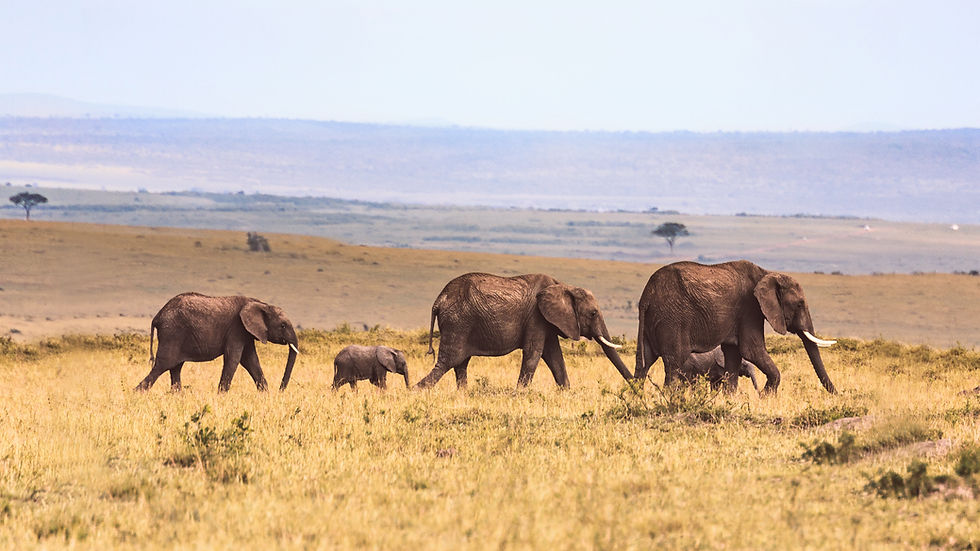
In an era when children face relentless pressures—from academic demands and extracurricular schedules to the constant pull of social media and digital entertainment—places like Kruger offer a rare antidote. Here, the rhythm is dictated by nature rather than notifications. Internet connectivity remains limited in the rest camps, encouraging disconnection and presence. Patience is cultivated during those extended game drives, where hours might pass before a leopard appears in the branches or a herd of elephants crosses the road. Rather than consuming wildlife through videos, children observe authentic behaviours: the intricate social dynamics of a baboon troop, the patient stalking of a predator, and the interdependence of ecosystems. Such immersion fosters resilience, empathy for the environment, and a grounded appreciation for life's cycles—benefits that extend to adults as well, often prompting reflection on our own hurried lives.
Accessibility for All Ages
Kruger National Park stands out for its accessibility across age groups. Families with older children and teenagers find it especially rewarding, though even younger ones engage deeply if outings are paced thoughtfully. Infants and toddlers may find the long car journeys challenging due to heat, dust, and confinement, so shorter drives or breaks are advisable. Yet every age has something to gain: the youngest delight in basic sightings and sounds, while older children can pursue more detailed interests—learning to identify animal tracks, deciphering behaviours, distinguishing species, or understanding habitats from riverine forests to open savannas. With an extraordinary abundance of wildlife, including the iconic Big Five (lion, leopard, elephant, rhino, buffalo), boredom is fleeting; sightings arrive with delightful frequency.
Engaging Activities for Young Explorers
To enhance the educational value and keep young minds engaged throughout the trip, it helps to prepare activities related to the animals and ecosystems you'll encounter. Simple preparations like discussing key species in advance or using sighting checklists turn each drive into an interactive exploration. There are shops located at different camps selling wildlife activity books for children as well as Kruger Park merchandise.

Vast Landscapes and Diverse Wildlife
Covering nearly 20,000 square kilometres—roughly the size of Israel or the state of New Jersey—Kruger is one of Africa's premier wildlife sanctuaries, supporting over 500 bird species and 147 mammal species amid varied landscapes that ensure no two drives feel repetitive. The park maintains clear, sensible rules to protect both visitors and animals: remain in your vehicle except at designated picnic sites or hides; observe speed limits (typically 50 km/h on paved roads, 40 km/h on gravel); adhere to gate opening and closing times (generally around dawn to dusk, varying seasonally); refrain from feeding wildlife, using drones, or venturing off-road. These measures create a safe, respectful environment for all. Make sure that you have a spare car tyre and are able to change it if need be on one of the more remote roads in the park.
The Freedom of Self-Driving
What distinguishes Kruger for independent travellers is the freedom of self-driving. No need for costly private safaris or guided vehicles—you can rent a car from Johannesburg (a straightforward 4–5 hour drive to southern gates like Crocodile Bridge or Malelane) or nearby airports such as Kruger Mpumalanga International. Compact rentals often start around $30–50 USD per day, allowing families to explore at their own pace, pausing for sightings, hides, or child-friendly stops.
Costs remain remarkably reasonable for such an exceptional experience. As of the period from 1 November 2025 to 31 October 2026, daily conservation fees for international visitors are R602 per adult and R300 per child (ages 2–11), equivalent to approximately $33–35 USD per adult and $16–18 USD per child, depending on exchange rates (children under 2 enter free). Overnight accommodation in the park's SANParks rest camps offers excellent value: basic campsites begin around $20–25 USD per person per night, while self-catering bungalows or chalets (with en-suite facilities and kitchenettes) at popular camps like Skukuza, Lower Sabie, or Berg-en-Dal typically range from $80–150 USD per unit per night for 2–4 people, depending on season and type. Book early through the official SANParks site, as demand peaks in dry winter months (June–August) and South African school holidays.
If you prefer to leave the organisation to someone else, consider pre-booking professionally guided safaris and all-inclusive stays through a company such as Nhongo Safaris.

Safety in the Wilderness
Regarding safety, South Africa faces challenges with crime in urban centres, yet Kruger National Park remains a secure haven for tourists. Fenced rest camps, dedicated ranger presence, and gated access minimise risks inside the park, where incidents are exceedingly rare. With basic precautions—travelling during daylight, using main roads, securing valuables, and avoiding isolated areas outside the park—most visitors encounter no issues. The rewards of this remarkable place far outweigh any perceived concerns.
A Journey Beyond Pixels
A family visit to Kruger is more than a holiday; it's an opportunity to reconnect with something elemental. For my son, it opened a window to a world beyond pixels and pressures. If you're considering a self-drive safari with children, Kruger delivers accessibility, wonder, and affordability in equal measure. Share your own bush stories below—I’d love to hear them.


Is Mozambique a good destination for a family for a few months?